How Earthquakes Happen 600 Kilometers Down: The Puzzle of Deep-Focus Seismicity
Rock at 600 kilometers is under enormous pressure and should flow, not break. Yet large earthquakes start there. Here is what the two biggest deep events revealed and why no single explanation fits.
Earthquakes Below the Brittle Zone
Most earthquakes begin within a few tens of kilometers of the surface, where cold rock breaks and slides along faults. A small share begins far deeper, inside oceanic plates that are sinking into the mantle. Earthquakes below about 70 kilometers are often grouped together as deep events (Wang et al. 2017). Within subducting plates, events shallower than 300 kilometers are defined as intermediate-depth earthquakes, and those deeper than 300 kilometers are considered deep-focus earthquakes (Hasegawa and Nakajima 2017). sisma.io uses the same boundaries in its depth labels: shallow above 70 kilometers, intermediate from 70 to 300, and deep below 300.
The deepest population occurs between about 325 and 690 kilometers, an interval that closely brackets the mantle transition zone, where the main minerals of the upper mantle change to denser crystal structures (Kirby et al. 1996). The existence of these earthquakes poses a problem. Green and Burnley (1989) point out that brittle fracture and frictional sliding at depths greater than 100 to 200 kilometers would require unrealistic rock strengths. Hasegawa and Nakajima (2017) put the difficulty in terms of stress: an earthquake at such depths would need shear stress to exceed a very large frictional strength, yet the earthquakes do occur, so some special mechanism must lower the strength of the fault. Several plausible mechanisms have been proposed, and the exact one remains unresolved (Hasegawa and Nakajima 2017).
Where Deep Earthquakes Occur and How They Behave
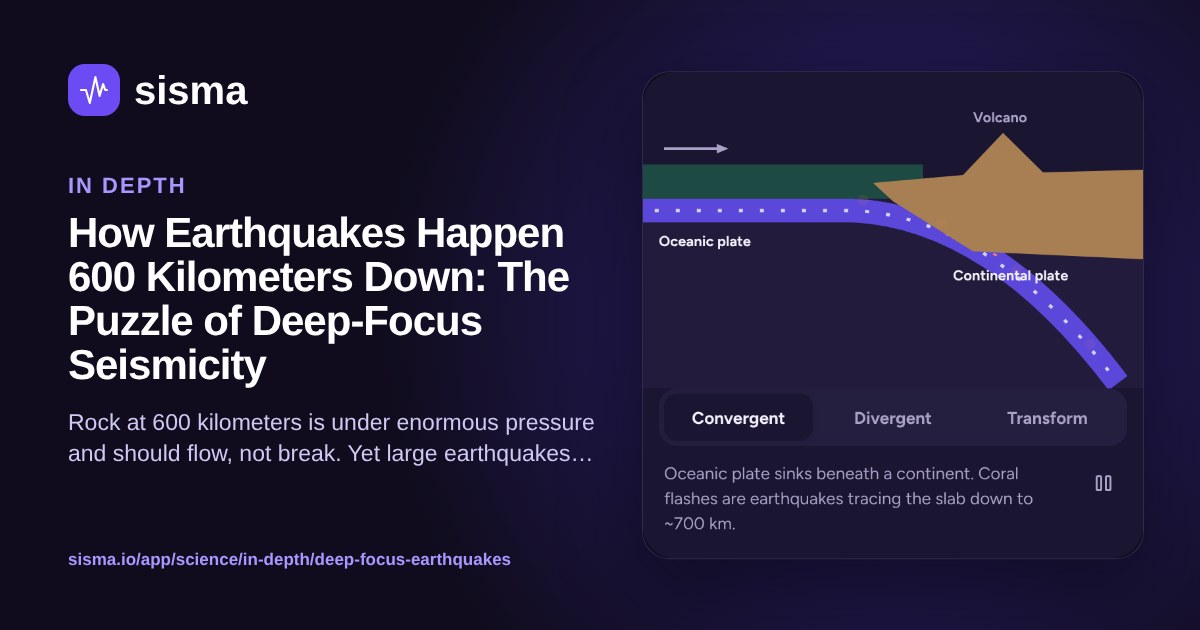
Deep earthquakes occur in subducting or previously subducted oceanic lithosphere (Kirby et al. 1996). They follow dipping planar bands known as Wadati-Benioff zones, which trace the cold, down-going cores of the sinking plates (Wang et al. 2017). The number of earthquakes falls almost exponentially with depth to about 300 kilometers, reaches a minimum between about 300 and 450 kilometers, and rises again to a local maximum at 550 to 600 kilometers (Hasegawa and Nakajima 2017). Activity then ends abruptly near 700 kilometers (Wang et al. 2017).
Zhan (2020) summarizes the observations in a review: deep earthquakes behave like shallow earthquakes but must have fundamentally different physical processes, and their rupture behavior, size statistics and aftershocks are diverse and depend imperfectly on factors such as slab temperature, depth and magnitude. Deep events generally produce few aftershocks and leave no surface rupture or geodetic signal, which makes the size of their ruptures hard to estimate (Zhan et al. 2014).
For readers who follow earthquakes, the practical consequence is that deep earthquakes usually do not cause enough shaking at the surface to be hazardous, although they are of great scientific interest (University of California, Santa Cruz 2013). A deep event of magnitude 6 or 7 can therefore appear on a tracking site as a large number with little or no reported damage, because the rupture lies hundreds of kilometers below the ground.
Two Record-Setting Events
Two earthquakes anchor most discussion. On 9 June 1994, a deep earthquake struck beneath Bolivia. Silver et al. (1995) give its moment magnitude as 8.3 and its depth as 636 kilometers, and describe it as the largest deep-focus earthquake recorded up to that time. The USGS catalog lists the same event as magnitude 8.2 at a depth of 631 kilometers (USGS n.d.a). On 24 May 2013, a magnitude 8.3 earthquake ruptured a 180-kilometer-long fault within the subducting Pacific plate about 609 kilometers below the Sea of Okhotsk (Ye et al. 2013). The USGS catalog lists it as magnitude 8.3 at 598 kilometers (USGS n.d.b). Different methods give depths that differ by several kilometers, so published figures vary slightly.
The Okhotsk earthquake had a seismic moment 30 percent larger than that of the Bolivia event and released about three times as much energy (University of California, Santa Cruz 2013). Ye et al. (2013) measured a rupture velocity of about 4.0 to 4.5 kilometers per second and a static stress drop of about 12 to 15 megapascals, values compatible with theoretical radiation efficiency for crack models. A nearby aftershock had a stress drop one to two orders of magnitude higher, which the authors read as large stress heterogeneity in the deep slab. Thorne Lay, a coauthor of the study, called it a mystery how rock can slide against rock so fast while squeezed by the pressure of 610 kilometers of overlying rock (University of California, Santa Cruz 2013).
The two events ruptured differently. Zhan et al. (2014) found that the Okhotsk earthquake was mostly unilateral, rupturing about 90 kilometers along strike at more than 4 kilometers per second, while the Bolivia earthquake ruptured about half that distance at a slow velocity of about 1.5 kilometers per second and showed a major change in rupture direction. The difference matters because each candidate mechanism implies different behavior in rupture speed and extent. A fast, long rupture with a moderate stress drop resembles a shallow earthquake; Lay said of Okhotsk that it looks a lot like a shallow event (University of California, Santa Cruz 2013). The slow Bolivia rupture behaved differently, so no single description fits both.
Mechanism One: Transformational Faulting
Olivine, the main mineral of the upper mantle, converts to denser structures as pressure rises. In old, cold slabs that reaction is kinetically hindered, so wedge-shaped zones of metastable olivine-bearing rock probably persist to depths of more than 600 kilometers (Kirby et al. 1996). Laboratory experiments on some metastable minerals show a shear instability called transformational faulting, in which the host mineral fails suddenly in thin shear zones where it transforms to a denser, finer-grained phase (Kirby et al. 1996). Green and Burnley (1989) observed this faulting in a germanium analogue of olivine, Mg2GeO4, and proposed that it arises from the generation, propagation and linking-up of small inclusions filled with the denser phase. Hasegawa and Nakajima (2017) describe the same idea in terms of small lens-shaped crystals of the new phase that grow and align along a plane until they form a fault.
Laboratory work supports the picture. Schubnel et al. (2013) recorded acoustic emissions resembling deep earthquakes in Mg2GeO4 olivine deformed at pressures of 4 to 5 gigapascals while it transformed, combining synchrotron X-ray measurements with acoustic monitoring (Wang et al. 2017). A 2022 study used natural (Mg,Fe)2SiO4 olivine at 11 to 17 gigapascals and 860 to 1350 kelvin, conditions equivalent to slabs in the transition zone. Through-going faulting occurred only within a narrow temperature window of 1100 to 1160 kelvin, accompanied by intense acoustic emissions at the onset of rupture. Fault sliding, aided by shear heating, occurred along a weak layer formed by the linking-up of lens-shaped packets of nanocrystalline olivine and wadsleyite (Ohuchi et al. 2022).
The hypothesis fits two observations: deep seismicity closely brackets the transition zone, and metastable olivine wedges are expected only in old, cold slabs (Kirby et al. 1996). It also faces objections. An early version, in which a sudden collapse of the mineral to a denser form produces the earthquake, would create a large isotropic, or implosive, component in the source, and deep earthquakes generally lack one (Hasegawa and Nakajima 2017). Silver et al. (1995) found that the Bolivia rupture extended at least 30 by 50 kilometers, more than three times the size expected for a metastable olivine wedge at the core of the slab, which they considered incompatible with an origin by transformational faulting.
Mechanism Two: Dehydration Embrittlement
Subducting plates carry water-bearing minerals that break down as pressure and temperature rise. Under the dehydration embrittlement hypothesis, water expelled from these minerals generates earthquakes by raising the pore-fluid pressure in the rock. Hasegawa and Nakajima (2017) note that the details of how local excess pore pressure leads to rupture are still debated. They conclude that water from the slab plays an important role in generating intermediate-depth earthquakes, with rupture possibly starting through local excess pore pressure and then propagating through thermal shear instability.
Extending the idea below 300 kilometers is harder. The UC Santa Cruz release on the Okhotsk earthquake noted that fluid can lubricate a fault, but that all of the fluids should have been squeezed out of the slab before it reached that depth (University of California, Santa Cruz 2013). Zhang et al. (2021) nonetheless argue that dehydration embrittlement is a plausible alternative model for the Okhotsk event. Their argument rests on the orientation and size of the plane that ruptured, its rupture velocity and radiation efficiency, and diverse evidence that water is carried as deep as the transition zone and below. It is one of several competing interpretations of that earthquake.
Mechanism Three: Thermal Runaway
The third hypothesis, thermal shear instability, starts with plastic deformation. If the rock deforms faster than the heat generated can escape, a positive feedback promotes further deformation. Deformation then proceeds rapidly until material in that part of the slab starts to melt, which produces sudden slip, that is, an earthquake (Hasegawa and Nakajima 2017).
Lay gave a similar description for Okhotsk: if the fault slips just a little, friction could melt the rock and provide the fluid, producing a runaway thermal effect. He added that something must first start the sliding (University of California, Santa Cruz 2013). Zhan et al. (2014) propose that this kind of shear melting operates inside warm slabs once a rupture has been triggered.
Where Scientists Disagree
A review by Zhan (2020) reaches a plain conclusion about the three leading mechanisms. Transformational faulting, dehydration embrittlement and thermal runaway can each explain portions of the observations, and each has potentially fundamental difficulties explaining the rest. The review calls for more serious consideration of hypotheses that involve more than one mechanism: a deep earthquake might initiate by one process and propagate by another once triggered.
Comparison of the two largest events points the same way. Zhan et al. (2014) explain the differences between them as the result of two fundamentally different faulting mechanisms in slabs with different thermal states: transformational faulting inside the metastable olivine wedge in cold slab cores, and shear melting inside warm slabs once triggered. Lay noted that a transformation of mineral forms might give the initial kick, but that scientists cannot detect it directly (University of California, Santa Cruz 2013). That detection problem leaves the question of how ruptures begin open even where their propagation is better constrained.
Scale is another limit. The olivine samples in the 2022 experiments were 1.2 millimeters long (Ohuchi et al. 2022), while the Okhotsk rupture extended over many kilometers of fault. Researchers studying laboratory ruptures in millimeter-sized samples have noted that scaling issues between laboratory events and deep-focus earthquakes remain to be resolved (Wang et al. 2017). Each large deep event adds a constraint on slab temperature, mineral content and strength at depths no drill can reach. For readers watching a live earthquake feed, a large deep earthquake is therefore mainly a research opportunity, because the depth that makes it hard to explain also keeps most of its shaking far from the surface.
Frequently asked questions
- What is a deep-focus earthquake?
- A deep-focus earthquake starts more than 300 kilometers below the surface, inside an oceanic plate that is sinking into the mantle. Earthquakes between about 70 and 300 kilometers are called intermediate-depth. The deepest earthquakes occur between about 325 and 690 kilometers, and activity ends abruptly near 700 kilometers.
- Why are deep earthquakes hard to explain?
- At depths beyond 100 to 200 kilometers, the pressure is so great that ordinary brittle fracture and frictional sliding would require unrealistic rock strengths. Rock at those depths would normally deform slowly instead of breaking, so some special mechanism must weaken the fault.
- What is the largest deep earthquake ever recorded?
- The magnitude 8.3 Sea of Okhotsk earthquake of 24 May 2013, about 600 kilometers deep. Its seismic moment was about 30 percent larger than that of the 1994 Bolivia earthquake, the previous record holder, and it released about three times as much energy.
- Are deep earthquakes dangerous?
- Deep earthquakes usually do not cause enough shaking at the surface to be hazardous, because the rupture lies hundreds of kilometers down.
- What are the main explanations for deep earthquakes?
- The three leading hypotheses are transformational faulting, where olivine that has stayed in its low-pressure form suddenly transforms along thin zones; dehydration embrittlement, where water released from minerals weakens the rock; and thermal runaway, where rapid deformation heats and melts a narrow zone. Each explains part of the observations.
- Do scientists agree on what causes deep earthquakes?
- No. A 2020 review concluded that each leading mechanism has potentially fundamental difficulties and suggested that a deep earthquake might start by one mechanism and continue by another. Studies of the 1994 Bolivia and 2013 Okhotsk events suggest that cold and warm slabs may fail in different ways.
References
- Green, Harry W., II, and Pamela C. Burnley. 1989. "A New Self-Organizing Mechanism for Deep-Focus Earthquakes." Nature 341: 733–37. doi.org/10.1038/341733a0.
- Hasegawa, Akira, and Junichi Nakajima. 2017. "Seismic Imaging of Slab Metamorphism and Genesis of Intermediate-Depth Intraslab Earthquakes." Progress in Earth and Planetary Science 4: 12. doi.org/10.1186/s40645-017-0126-9.
- Kirby, Stephen H., Seth Stein, Emile A. Okal, and David C. Rubie. 1996. "Metastable Mantle Phase Transformations and Deep Earthquakes in Subducting Oceanic Lithosphere." Reviews of Geophysics 34 (2): 261–306. doi.org/10.1029/96RG01050.
- Ohuchi, Tomohiro, Yuji Higo, Yoshinori Tange, Takeshi Sakai, Kohei Matsuda, and Tetsuo Irifune. 2022. "In Situ X-Ray and Acoustic Observations of Deep Seismic Faulting upon Phase Transitions in Olivine." Nature Communications 13: 5213. doi.org/10.1038/s41467-022-32923-8.
- Schubnel, Alexandre, Fabrice Brunet, Nadège Hilairet, Julien Gasc, Yanbin Wang, and Harry W. Green II. 2013. "Deep-Focus Earthquake Analogs Recorded at High Pressure and Temperature in the Laboratory." Science 341 (6152): 1377–80. doi.org/10.1126/science.1240206.
- Silver, Paul G., Susan L. Beck, Terry C. Wallace, Charles Meade, Stephen C. Myers, David E. James, and Randy Kuehnel. 1995. "Rupture Characteristics of the Deep Bolivian Earthquake of 9 June 1994 and the Mechanism of Deep-Focus Earthquakes." Science 268 (5207): 69–73. doi.org/10.1126/science.268.5207.69.
- University of California, Santa Cruz. 2013. "Seismologists Puzzle over Largest Deep Earthquake Ever Recorded." News release, September 19, 2013. Reprinted by ScienceDaily. www.sciencedaily.com/releases/2013/09/130919142152.htm.
- USGS (U.S. Geological Survey). n.d.a. "M 8.2 – 55 km NNW of Reyes, Bolivia." Earthquake Hazards Program event page, 9 June 1994. earthquake.usgs.gov/earthquakes/eventpage/usp0006dzc.
- USGS (U.S. Geological Survey). n.d.b. "M 8.3 – 2013 Sea of Okhotsk Earthquake." Earthquake Hazards Program event page, 24 May 2013. earthquake.usgs.gov/earthquakes/eventpage/usb000h4jh.
- Wang, Yanbin, Lupei Zhu, Feng Shi, Alexandre Schubnel, Nadège Hilairet, Tony Yu, Mark Rivers, Julien Gasc, Ahmed Addad, Damien Deldicque, Ziyu Li, and Fabrice Brunet. 2017. "A Laboratory Nanoseismological Study on Deep-Focus Earthquake Micromechanics." Science Advances 3 (7): e1601896. doi.org/10.1126/sciadv.1601896.
- Ye, Lingling, Thorne Lay, Hiroo Kanamori, and Keith D. Koper. 2013. "Energy Release of the 2013 Mw 8.3 Sea of Okhotsk Earthquake and Deep Slab Stress Heterogeneity." Science 341 (6152): 1380–84. doi.org/10.1126/science.1242032.
- Zhan, Zhongwen. 2020. "Mechanisms and Implications of Deep Earthquakes." Annual Review of Earth and Planetary Sciences 48: 147–74. doi.org/10.1146/annurev-earth-053018-060314.
- Zhan, Zhongwen, Hiroo Kanamori, Victor C. Tsai, Donald V. Helmberger, and Shengji Wei. 2014. "Rupture Complexity of the 1994 Bolivia and 2013 Sea of Okhotsk Deep Earthquakes." Earth and Planetary Science Letters 385: 89–96. doi.org/10.1016/j.epsl.2013.10.028.
- Zhang, Hao, Suzan van der Lee, Craig R. Bina, and Zengxi Ge. 2021. "Deep Dehydration as a Plausible Mechanism of the 2013 Mw 8.3 Sea of Okhotsk Deep-Focus Earthquake." Frontiers in Earth Science 9: 521220. doi.org/10.3389/feart.2021.521220.