Earthquake Lights: What the Flashes Are and Why They Are Debated
Flashes, glowing bands and orbs have been reported around earthquakes since antiquity. Here is what the photographs, video and catalogues show, how rock might make light, and what is still unsettled.
What Earthquake Lights Are
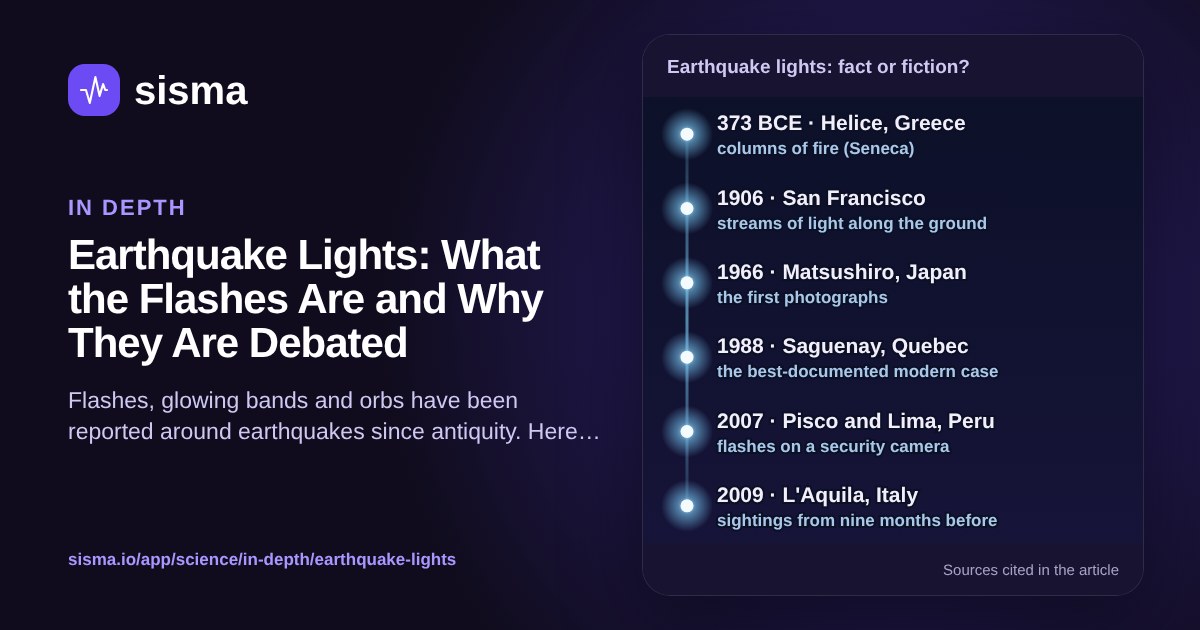
Earthquake lights are unusual luminous displays that appear before or during an earthquake, or within its aftershock sequence, and are presumed to arise from the accumulation and release of tectonic stress (Derr et al. 2021). Observers have described flashes, glowing bands, drifting orbs, small flames near the ground and flames emerging from it. The earliest known report dates to 373 BCE, when an earthquake destroyed the Greek cities of Helice and Buris and, according to Seneca, was accompanied by columns of fire (Derr et al. 2021). Derr (1973) published an early review of the observations and the theories offered for them.
Even the definition is contested. Derr et al. (2021) note disagreement over whether the term covers luminous phenomena seen in earthquake-prone regions or along faults without an immediately associated earthquake. This article treats lights reported close in time to seismic activity.
Photographs and Witnesses: Matsushiro and Saguenay
The first photographs came from the Matsushiro swarm in central Japan, which began on 3 August 1965 (Physics World 2014; St-Laurent, Derr, and Freund 2006). Its largest shock was magnitude 5.4 on 5 April 1966, and the combined energy of the whole swarm equaled a single magnitude 6.4 earthquake (Japan Meteorological Agency n.d.a). A photographer named Kuribayashi recorded a light at 3:25 a.m. on 26 September 1966 that followed a line of mountains including Mount Kimyo. By his own account it lasted 96 seconds at an elevation of 5 to 15 degrees and for 40 seconds was about three times as bright as a full moon (Japan Meteorological Agency n.d.b). A caption in a popular source dates the best-known Mount Kimyo photograph to 1968 (National Geographic n.d.a), a discrepancy that requires independent verification.
The best-documented modern case is the Saguenay region of Quebec. The main shock occurred at 18:46 local time on 25 November 1988 and is listed at magnitude 6.5 on the mbLg scale (St-Laurent, Derr, and Freund 2006), while a popular account gives 5.9 (Fortean Times 2019); the difference requires independent verification. St-Laurent (2001) counted 46 luminosities during 67 earthquakes between November 1988 and the end of January 1989, and 8 of those sightings preceded the magnitude 4.8 foreshock of 23 November. Ouellet (1990) tied sightings to 54 seismic shocks, so the counts differ by author. St-Laurent sorted the reports into types that include luminous bands in the atmosphere, globular incandescent masses, small mobile flames near the ground and flames emerging from the ground. Globular masses were the most common, with 22 reports from different places (Corliss 2000, summarizing St-Laurent).
Two earlier reports describe light ahead of shaking. A bright purple-pink globe moved along the St. Lawrence River near Quebec City on 12 November 1988, 11 days before a powerful earthquake. In 1906 a couple about 100 km northwest of San Francisco saw streams of light running along the ground two nights before the great earthquake (Seismological Society of America 2014).
Where and When the Lights Appear
The most systematic test came from Thériault et al. (2014), who compiled 65 well-documented earthquakes with light reports since 1600, 27 in the Americas and 38 in Europe (Scientific American 2014). Of the documented cases, 97 percent appeared adjacent to subvertical faults, a class of faults responsible for about 5 percent of seismic activity, and the lights occurred before or during earthquakes and rarely afterward (Seismological Society of America 2014). Magnitudes ranged from 3.5 to 9.2, and 80 percent of the events exceeded magnitude 5.0 (Physics World 2014).
The authors propose that deeply penetrating subvertical faults, common in rift settings and absent from subduction zones, channel stress-generated electrical charge to the surface, where it ionizes air (Physics World 2014). For lights that appear before an earthquake, the authors see a relation to the rapid buildup of stress deep underground before fault rupture (Physics World 2014).
This is an idea that's up for debate. Kato, a geophysicist at Kyoto University, argues that the study does not account for sampling bias: intraplate earthquakes make up a small share of all events but often strike inhabited areas, where a related phenomenon is more likely to be seen. He considers the conclusions possibly premature (Physics World 2014). Freund, a co-author, says earthquake lights are heavily underreported (NBC News 2014), which complicates any count of how often they occur.
The 2009 L'Aquila earthquake in central Italy illustrates the timing question. Fidani (2010) compiled a catalogue of testimonials about the magnitude 6.3 shock of 6 April 2009, which struck at 03:32 local time. Luminous phenomena were reported from about nine months before the shock until about five months after it, over a large area extending up to 50 km north of the city. Because the catalogue rests on testimony gathered after the event, the long window makes any single sighting difficult to place in the sequence.
Flashes on Camera: Pisco, Peru, 2007
Video evidence changed the discussion. A magnitude 8.0 earthquake struck near Pisco at 18:40:57 local time on 15 August 2007, after dark. In Lima, about 150 km from the epicenter, a fixed security camera at the Pontificia Universidad Catolica del Peru faced the ocean and recorded five flashes within a 25-degree field of view. Each flash lasted one to four frames at roughly four frames per second (Heraud and Lira 2011).
The flashes followed the first by about 9.6, 10.2, 74.8 and 89.6 seconds. Accelerometer peaks followed the first peak by about 8.2, 8.2, 72.1 and 89.1 seconds, which the authors describe as a good but imperfect match. The camera clock was not synchronized with the seismic instruments, so the comparison rests on intervals between events (Heraud and Lira 2011). Physics World (2014) reports that the cameras captured lights forming in the air as shear waves passed through the ground. Heraud and Lira (2011) report a delay of about 30 seconds after the P-wave arrival and about 18 seconds after the S-wave arrival.
Witnesses described white and light blue light. A pilot on approach saw lights on hills and thought of St. Elmo's fire, and a navy officer on San Lorenzo Island saw columns of light rising from the sea (Heraud and Lira 2011). The authors checked for power-line arcing, found no substations near the lit hills, and found no utility or fire department records of arcing. The weather record showed a clear sky with no electrical activity. They conclude that the lights are probably a real phenomenon with timing tied to the shaking. They also list limits: a single camera, five timed flashes, evidence reconstructed about three years later, and no reported lights before or after the main shock (Heraud and Lira 2011).
How Rock Might Produce Light
The leading explanation comes from Freund and colleagues. Igneous rocks contain dormant pairs of defects that become mobile charge carriers, called positive holes, when stress is applied. In laboratory impacts on gabbro and diorite cores at about 100 meters per second, such carriers produced electric potentials above 400 millivolts, electromagnetic emission and light (Freund 2000). St-Laurent, Derr, and Freund (2006) propose that when the carrier concentration reaches a critical level, the holes form a plasma-like charge cloud that breaks out of the stressed rock volume. At the surface the charge causes dielectric breakdown of air, producing corona discharge with light and high-frequency radio emission. They also suggest that high carrier concentrations can accumulate at fault asperities.
Earlier proposals invoked the piezoelectric effect, in which quartz-bearing rocks generate voltage under pressure; one experimenter reported light flashes in a darkened room from stressed rocks (Christian Science Monitor 1982). The positive hole theory remains disputed. A U.S. Geological Survey geophysicist, Malcolm Johnston, could not reproduce Freund's experiment, and Freund replies that the setup was incorrect and that piezoelectric and triboelectric effects cannot generate enough charge. Derr says the theory lacks a pivotal piece of real-world evidence (Nautilus n.d.). Heraud and Lira (2011) suggest that pointed rocks near the Peruvian coast could leak electrons into the air and that radon might enhance charge generation, a possibility that remains untested because radon was unmonitored.
Separating Earthquake Lights from Look-Alikes
Flash reports on social media require screening against ordinary electrical sources. After the 2017 Mexico earthquake, reported at magnitude 8.1, images of green and blue lights appeared online as earthquake lights (National Geographic n.d.b). An analysis posted on the Metabunk forum attributes many Mexico City flashes to sparks and transformer explosions from swaying power lines, reflected from a low cloud layer (West n.d.). That analysis is not peer reviewed.
The Lima study shows the checks that separate the two explanations: absence of nearby power infrastructure, absence of utility or fire records, a clear sky, and light sources over hills and ocean (Heraud and Lira 2011).
What Remains Unsettled
Several questions remain open. The catalogue statistics are limited by sampling bias and underreporting. The sighting windows around events such as L'Aquila are long. The positive hole mechanism has laboratory support but disputed replication. Heraud and Lira (2011) call for observations with magnetometers, radon monitoring and infrared instruments, measurements that would test the charge-release mechanism directly during an earthquake.
Frequently asked questions
- What are earthquake lights?
- Unusual luminous displays reported before or during an earthquake, or within its aftershock sequence, presumed to arise from the build-up and release of tectonic stress. Observers describe flashes, glowing bands, drifting orbs and small flames near or emerging from the ground. The earliest known report dates to 373 BCE.
- Have earthquake lights been photographed or filmed?
- Yes. The first photographs came from the Matsushiro earthquake swarm in central Japan, including a light recorded at 3:25 a.m. on 26 September 1966 along a line of mountains that included Mount Kimyo. During the magnitude 8.0 Pisco, Peru earthquake of 15 August 2007, a security camera in Lima, about 150 km from the epicenter, recorded five flashes whose timing roughly matched the ground shaking.
- Where do earthquake lights appear most often?
- In a compilation of 65 well-documented earthquakes with light reports since 1600, 97 percent of the cases appeared next to subvertical faults, a class of faults responsible for about 5 percent of seismic activity, and the lights came before or during the earthquakes and rarely afterward. Critics point to sampling bias and underreporting.
- What causes earthquake lights?
- The leading explanation is the positive hole theory of Freund and colleagues: stress activates charge carriers in igneous rock, which can flow to the surface and ionize the air, producing corona discharge and light. Laboratory impacts on rock cores produced voltages, electromagnetic emission and light, but the theory is disputed and an attempt to reproduce the experiment failed.
- How can earthquake lights be told apart from power-line flashes?
- Many flashes filmed during earthquakes come from swaying power lines arcing or transformers exploding. The Lima study shows the checks that rule these out: no power infrastructure near the lit hills, no utility or fire department records of arcing, a clear sky, and light sources over hills and the ocean.
- Can earthquake lights predict earthquakes?
- Not at present. Some lights have been reported days before an earthquake, but sighting windows can be long (around the 2009 L'Aquila earthquake they ran from about nine months before the shock to five months after), counts suffer from sampling bias and underreporting, and the proposed mechanism lacks direct measurements during an earthquake.
References
- Christian Science Monitor. 1982. "Bright Glows That Accompany Earthquakes May Be Electric." 7 July. csmonitor.com/1982/0707/070736.html.
- Corliss, William R. 2000. "The Saguenay Earthquake Lights." Science Frontiers, no. 130 (July-August). science-frontiers.com/sf130/sf130p10.htm.
- Derr, John S. 1973. "Earthquake Lights: A Review of Observations and Present Theories." Bulletin of the Seismological Society of America 63: 2177-2187.
- Derr, John S., France St-Laurent, Friedemann T. Freund, and Robert Thériault. 2021. "Earthquake Lights." In Encyclopedia of Solid Earth Geophysics. Cham: Springer. doi.org/10.1007/978-3-030-58631-7_205.
- Fidani, C. 2010. "The Earthquake Lights (EQL) of the 6 April 2009 Aquila Earthquake, in Central Italy." Natural Hazards and Earth System Sciences 10: 967-978. doi.org/10.5194/nhess-10-967-2010.
- Fortean Times. 2019. "Shake, Rattle and Glow." August 2019.
- Freund, Friedemann. 2000. "Time-Resolved Study of Charge Generation and Propagation in Igneous Rocks." Journal of Geophysical Research 105 (B5): 11001-11019.
- Heraud, J. A., and J. A. Lira. 2011. "Co-Seismic Luminescence in Lima, 150 km from the Epicenter of the Pisco, Peru Earthquake of 15 August 2007." Natural Hazards and Earth System Sciences 11: 1025-1036.
- Japan Meteorological Agency. n.d.a. "Overview of the Matsushiro Earthquake Swarm" [in Japanese]. Matsushiro Seismological Observatory. www.jma.go.jp/jma/kishou/know/jishin/matsushiro/about/mat-swarm.html.
- Japan Meteorological Agency. n.d.b. "List of Luminous Phenomenon Photographs" [in Japanese]. Matsushiro Seismological Observatory. www.jma.go.jp/jma/kishou/know/jishin/matsushiro/mat50/disaster/luminous.html.
- National Geographic. n.d.a. "Earthquake Lights." www.nationalgeographic.com/environment/natural-disasters/reference/earthquake-lights/.
- National Geographic. n.d.b. "Earthquake Lights." www.nationalgeographic.com/environment/article/earthquake-lights.
- Nautilus. n.d. "The Lightning Beneath Our Feet." nautil.us/the-lightning-beneath-our-feet-234835.
- NBC News. 2014. "Bizarre Earthquake Lights Tied to Rifts in Earth." 2 January. www.nbcnews.com/news/amp/wbna53992237.
- Ouellet, Marcel. 1990. "Earthquake Lights and Seismicity." Nature 348: 492.
- Physics World. 2014. "Study Homes in on the Cause of Earthquake Lights." 14 January. physicsworld.com/a/study-homes-in-on-the-cause-of-earthquake-lights/.
- Scientific American. 2014. "Mysterious Light Associated with Earthquakes Now Linked to Geological Rift Zones." www.scientificamerican.com/article/mysterious-light-associated-earthquakes/.
- Seismological Society of America. 2014. "Earthquake Lights Linked to Rift Environments, Subvertical Faults." News release, 2 January. www.eurekalert.org/news-releases/544938.
- St-Laurent, France. 2001. "The Saguenay, Quebec, Earthquake Lights of November 1988-January 1989." Conference abstract, Tunguska Space Center. tunguska.tsc.ru/ru/science/conf/2001/ro1/lau.
- St-Laurent, F., J. S. Derr, and F. T. Freund. 2006. "Earthquake Lights and the Stress-Activation of Positive Hole Charge Carriers in Rocks." Physics and Chemistry of the Earth 31 (4-9): 305-312. doi.org/10.1016/j.pce.2006.02.003.
- Thériault, Robert, France St-Laurent, Friedemann T. Freund, and John S. Derr. 2014. "Prevalence of Earthquake Lights Associated with Rift Environments." Seismological Research Letters 85: 149-178. doi.org/10.1785/0220130059.
- West, Mick. n.d. "Explained: Mexico City Earthquake Lights [Power Line Arcing and Transformer Explosions]." Metabunk (forum post). www.metabunk.org/goto/post?id=210656.